
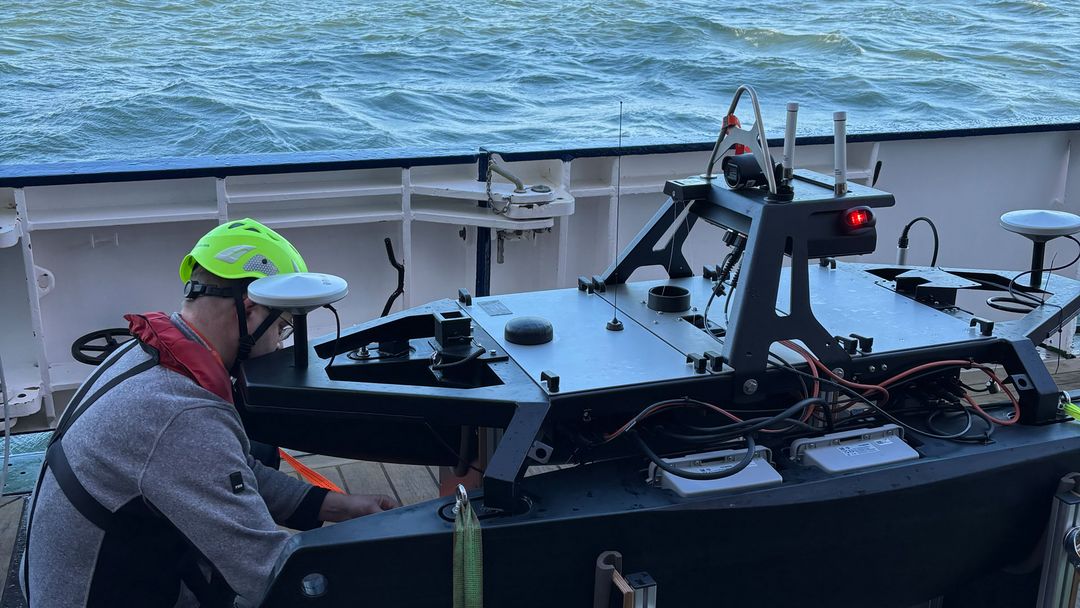
The deployment demonstrates how autonomous platforms can be integrated into existing research and measurement processes while providing high-resolution data, even in hard-to-access areas.
USV OTTER: A Flexible Platform for Maritime Data Collection
The deployed USV OTTER Pro, developed by Maritime Robotics, is a compact, seaworthy unmanned surface vehicle designed for autonomous measurement campaigns in coastal waters, protected marine areas, and inland waters. At DFKI, the system is used for maritime research scenarios and equipped with appropriate sensors for data acquisition.
Thanks to its compact design, the USV OTTER can operate in areas that are difficult for larger research vessels to access. It is particularly advantageous in the near-surface zone between 0 and 6 meters, enabling continuous, high-resolution data collection.
The sensor suite used includes, among others:
- a side-scan sonar (Norbit iWBMS) for detailed seabed mapping
- a CTD probe (AML-3 LGR) for measuring key oceanographic parameters such as conductivity, temperature, and depth
The vehicle can be operated either via manual remote control or autonomously along predefined waypoints. It is designed for use in low sea states with wave heights of up to 0.75 meters.
Four Deployments Under Real Conditions
During the expedition, the USV OTTER completed four sequential missions.
The first deployment focused on maneuverability, stability, and handling under real-world conditions.
In the second deployment, the USV OTTER followed a predefined waypoint pattern for bathymetric mapping. The side-scan sonar continuously provided high-resolution seabed data, while CTD measurements were conducted in parallel. Increasing sea state and rising wind speeds led to an early termination of the mission but also provided valuable insights into the system’s operational limits.
The third and fourth deployments took place in another test area north of Helgoland. Two structured survey patterns were conducted to achieve systematic area coverage. Due to time constraints, the planned pattern of the third deployment could not be fully completed. However, the fourth and final deployment was successfully carried out in full.
Complementing Traditional Research Methods
The deployments demonstrate how autonomous systems like USV OTTER can effectively complement existing marine research infrastructures. They enable flexible and scalable data collection, particularly in hard-to-access areas, and provide continuous measurement series with reduced personnel requirements.
At the same time, traditional oceanographic methods were used alongside the OTTER trials, including CTD profiles, current measurements using ADCP, and drifter experiments to analyze water mass movements in the German Bight. These served as reference and comparative data for the autonomous measurements.
Perspectives for Marine Research
The results of the deployments highlight the relevance of autonomous platforms for future marine research infrastructures. In combination with data-driven approaches and AI-supported analysis, new opportunities are emerging for more efficient and precise environmental monitoring.
The measurement campaign was conducted in close collaboration with the ICBM – Institute for Chemistry and Biology of the Marine Environment – and the Carl von Ossietzky University of Oldenburg, as well as other partners in German marine research. DFKI would like to thank all participants—especially cruise leader Dr. Thomas Badewien, the students for their dedication, and the crew of the research vessel HEINCKE—for the successful implementation under real operating conditions. Special thanks also go to the Carl von Ossietzky University of Oldenburg for the opportunity to test the USV OTTER during this North Sea research cruise.
Cooperation Partners:
Responsible institute: ICBM – Institute for Chemistry and Biology of the Marine Environment
Carl von Ossietzky University of Oldenburg
Alfred Wegener Institute for Polar and Marine Research
Briese Research – Briese Shipping GmbH & Co. KG