
Robotics and AI – Exoskeletons for Space and Everyday Life
Adaptive Assistance Systems for Training, Rehabilitation, and Space Travel
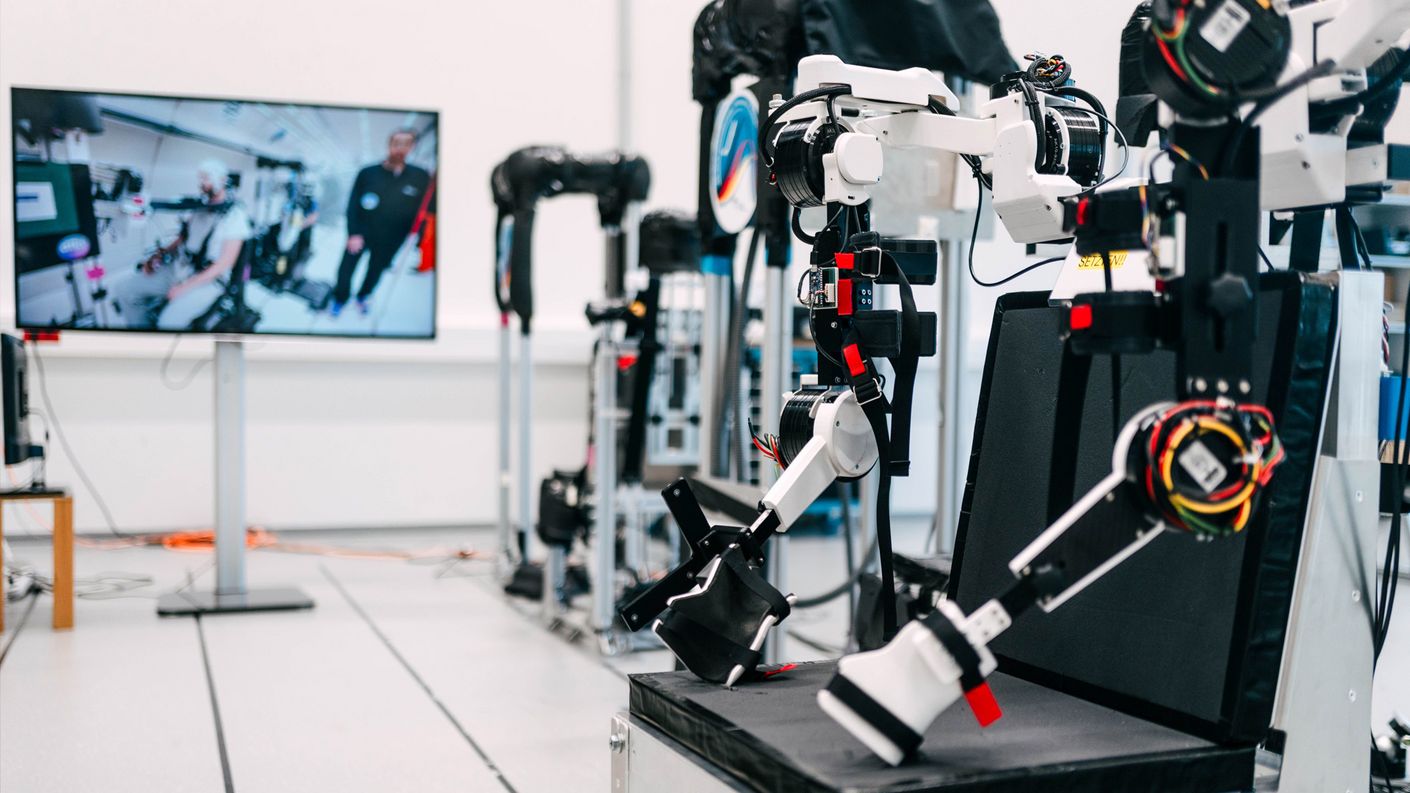
The Applied AI – Intelligent HealthCare Systems team at the DFKI Robotics Innovation Center (RIC) is showcasing an intelligent exoskeleton that sets new standards for training, rehabilitation, and human-machine interaction.
With almost 20 years of experience in exoskeleton research and the analysis of multimodal biosignals such as EEG, EMG, and ECG data, the team develops adaptive systems that automatically adjust to dynamic requirements. The AI learns from movement and vital data, interprets complex patterns in real time, and provides users with optimal support tailored to the situation – in healthcare, astronaut training, or everyday life.
The active exoskeleton from the RIC is used to study the effects of simulated and real microgravity on the movement kinematics of (un)trained humans. It compensates for the weight of an arm, thereby realistically simulating weightlessness. The goal is to develop fast, cost-efficient, and individualized training programs – with a view to future missions to the moon or Mars. The exoskeleton is being developed as part of the “MikroBeM” project, funded by the German Federal Ministry for Economic Affairs and Energy. In this project, the RIC is working with the University of Duisburg-Essen to research how astronauts can be specifically prepared for missions in weightlessness.
At the same time, the technology enables direct transfer to medicine and care: AI-supported exoskeletons open up new avenues in the rehabilitation of neuromotor disorders and thus contribute directly to the implementation of the German government's AI strategy.
Back to: DFKI at Hannover Messe 2026