
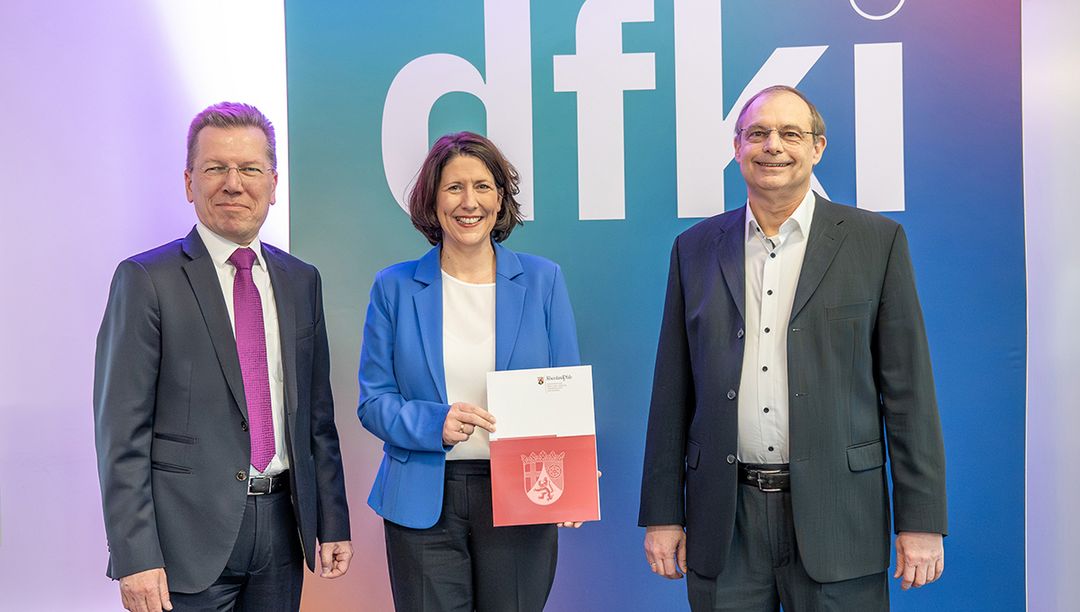
"The research results from the RAISE project serve to strengthen the innovation and competitiveness of small and medium-sized enterprises in Rhineland-Palatinate. DFKI is making an important contribution here by developing trustworthy, transparent, and practical AI technologies that can be integrated into existing business processes without high barriers to entry. The project is thus helping to create the conditions and structures for successful digital transformation and, at the same time, technological sovereignty for the regional economy," said Minister of Economic Affairs Daniela Schmitt at the announcement in Kaiserslautern. The DFKI has always been an important partner for the state government and the state's economy, contributing fundamentally to the competitiveness of Rhineland-Palatinate as a driver of innovation, according to the minister.
RAISE – Retrieval-Augmented Innovation and SME Enablement – aims to develop AI systems for small and medium-sized enterprises that work solely with the company's own data, thereby ensuring data security.
The project is financed by funds from the state of Rhineland-Palatinate and the European Regional Development Fund (ERDF). The total of around €570,000 is divided into around €360,000 in EU funds and around €210,000 in state funds.
RAISE focuses on the automated development and processing of unstructured company data. This is a prerequisite for efficient AI applications in areas such as customer service, quotation preparation, knowledge management, and compliance. The RAISE framework enables SMEs to independently develop prototypical AI solutions and integrate them into existing work processes – even without their own AI expert team and independently of proprietary large cloud platforms.
Technical details
Retrieval-augmented generation (RAG) systems combine the strengths of conventional information retrieval systems (such as search engines and databases) with the capabilities of generative large language models (LLMs). They use information directly from official and trustworthy company documents and do not require expensive and time-consuming training of a proprietary model.
The Experience-Based Learning Systems (EBLS) research group at DFKI in Trier will develop a generic and modular framework for RAGs to support companies in implementing and using these technologies.
Developed in close cooperation with companies – and scalable
To ensure that the solutions meet the real requirements of medium-sized companies, RAISE is being implemented in close cooperation with partners such as the SMEs of the “Eifelkreis Digital” association. This ensures that the needs of SMEs are systematically incorporated into the development process.
The project attaches great importance to reusability, transparency, and scalability. Topics such as data protection, system maintenance, and technological development are an integral part of the project concept.
In order to make the results usable far beyond the project partners, RAISE relies on a comprehensive transfer strategy. Among other things, open-source components, hackathons, practice-oriented specialist workshops, and other formats for knowledge transfer are planned. The project thus makes an important contribution to strengthening the digital sovereignty and innovative capacity of the regional economy.
“With RAISE, we are creating a real milestone for small and medium-sized enterprises in Rhineland-Palatinate,” says Prof. Ralph Bergmann, head of the research area for experience-based learning systems at DFKI and the University of Trier. “We enable companies to use AI applications confidently, securely, and efficiently—and thus strengthen their competitiveness in the long term.”